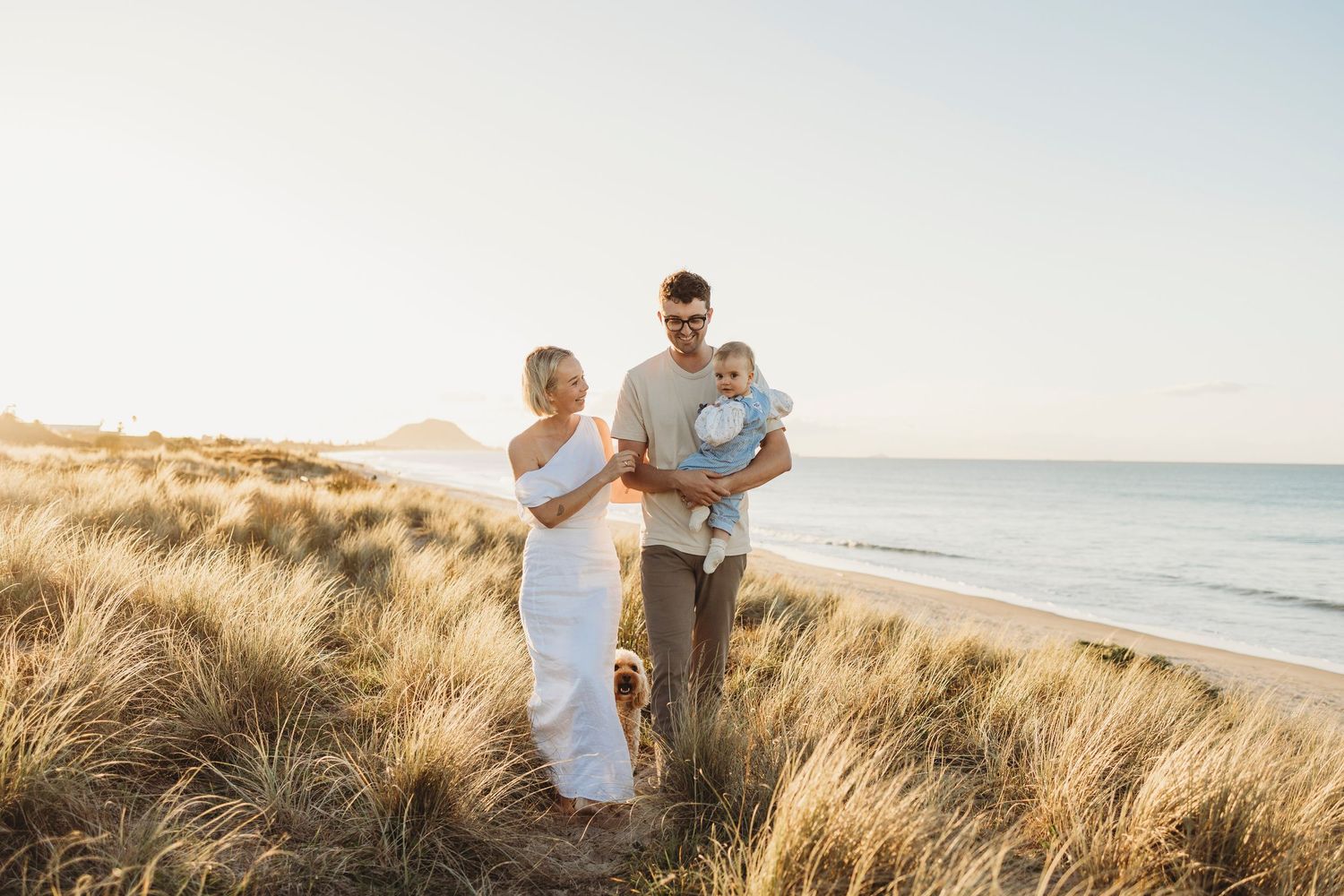
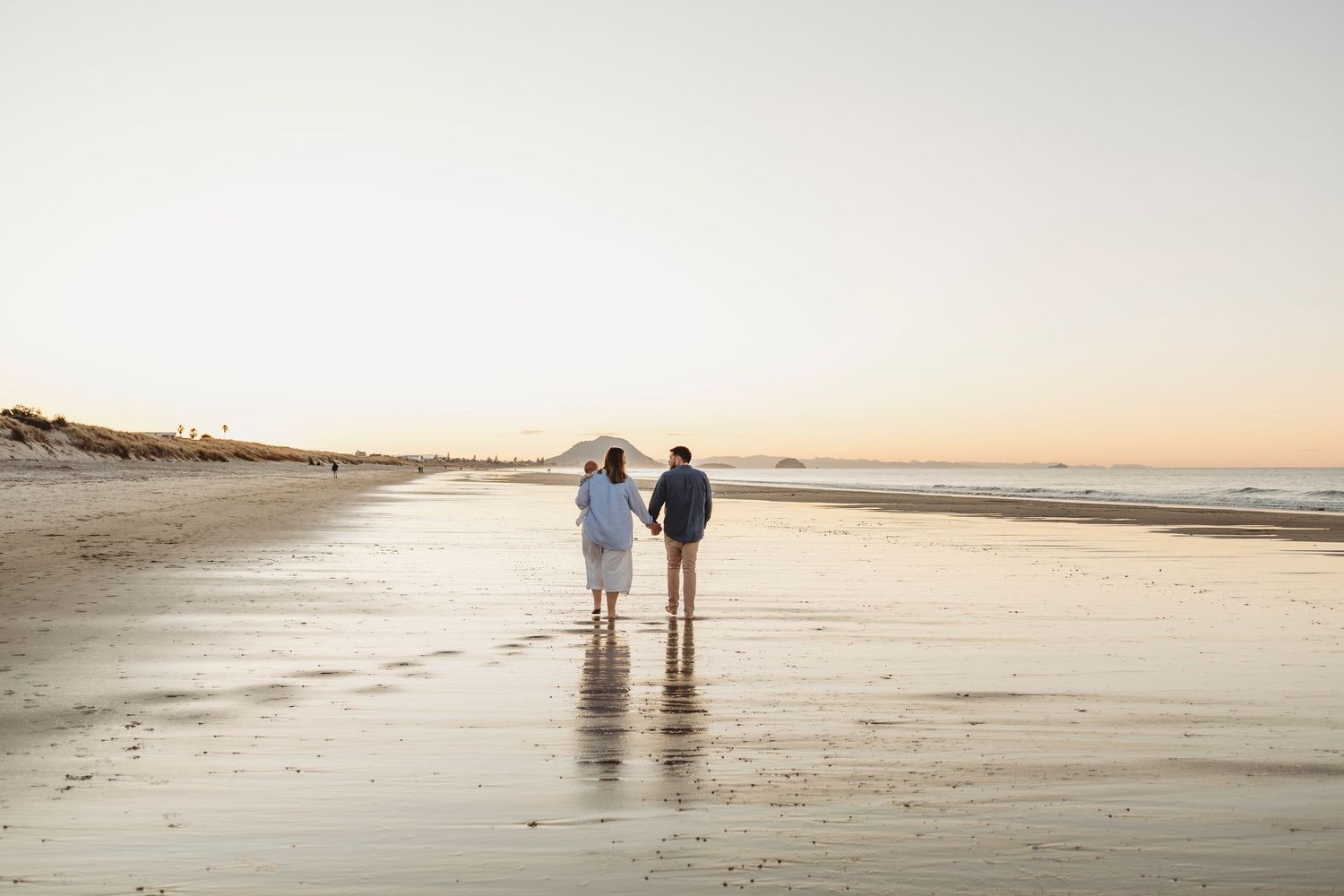
If you've ever booked a family photography session or maternity shoot and heard your photographer say "sessions are held at golden hour," you might have assumed you're getting a full sixty minutes of that gorgeous warm light. But the truth is in Pāpāmoa and across Tauranga, golden hour is closer to 20-35 minutes depending on the time of year and understanding why will completely change how you & your photographer plan your session.
Here's everything you need to know about light, the Kaimais and why the Pāpāmoa is one of the most iconic places in New Zealand to have your photos taken.

What Actually Is Golden Hour?
Golden hour is the window of time just after sunrise or just before sunset when sunlight travels through a much thicker slice of atmosphere than it does at midday. That extra distance strips out the harsh blue and white tones leaving behind warm reds, oranges and golds and beautiful soft, directional light.
The name "golden hour" was always a loose term. It was never meant to mean exactly sixty minutes! It's named for the quality of the light, not the duration. Think of it the way you'd say "I'll be there in a minute" it's shorthand for a feeling, not an actual measurement of time.
In Tauranga and Pāpāmoa specifically, golden "hour" varies between 20 - 40 minutes depending on the time of year:
Summer (December–February): 35–40 minutes
Autumn/Spring (March–May, September–November): 28–35 minutes
Winter (June–August): 20–25 minutes
WHY PāPāMOA GOLDEN HOUR IS UNIQUE
AKA THE KAIMAI EFFECT
Here's something your Tauranga photographer should know and something that makes shooting in Pāpāmoa genuinely different from other locations in the Bay of Plenty.
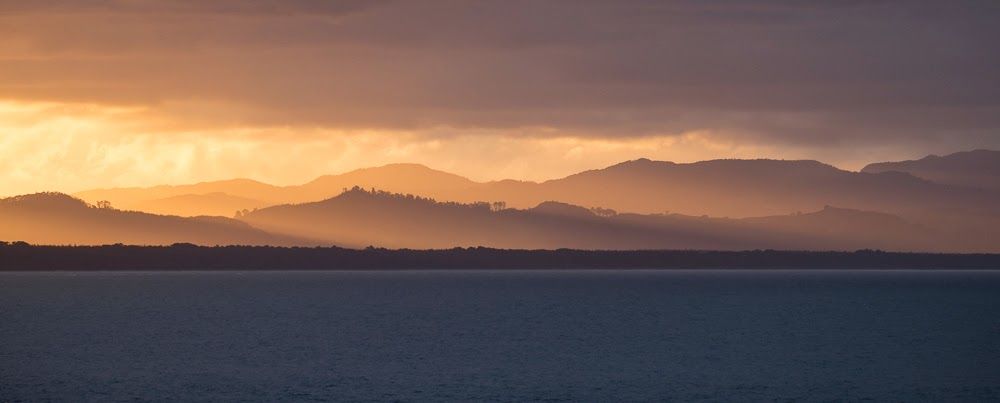
The Kaimai Range sits to the west and southwest of Pāpāmoa, rising to over 900 metres. Because the sun sets behind the Kaimais rather than at the true flat horizon, it disappears from view earlier than it technically should. In practice this means golden hour in Papamoa starts warm with that beautiful low light draping the dunes and beach but it ends abruptly as the sun moves behind the Kaimais. The upside of this is that it brings beautiful candy floss skies that last for a bit longer than they do at sunrise!
For family photography and maternity sessions on Pāpāmoa Beach, this means timing is everything. A photographer who knows the local landscape will schedule your session to make the most of that window before the ranges cut it short.
*stock image of the Kaimai ranges at sunset
Blue Hour
The most slept on time day
Blue Hour in Pāpāmoa is STUNNING! Its my secret weapon for maternity sessions.
Most people have heard of golden hour but not a lot know about blue hour and it's one of the most underrated time of day for maternity and family photography at Pāpāmoa Beach.
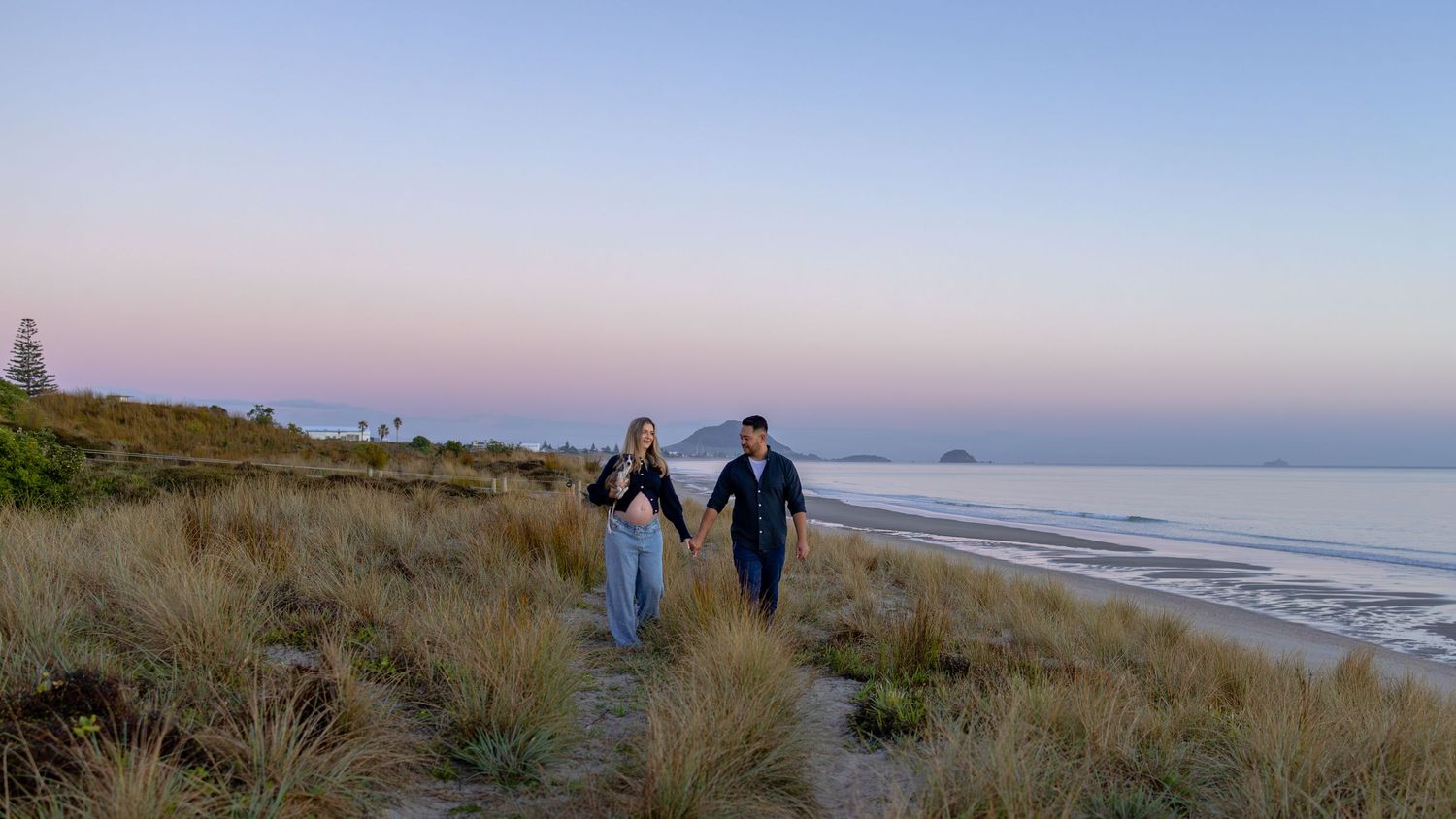
Blue hour happens a little after the sun sets when the sun drops roughly 3°–6° below the horizon. The sky shifts from warm gold through soft purple and into a deep blue. There's no direct sunlight, which means no harsh shadows, no squinting and no blown out highlights (something its of photographers struggle with). Just soft, cool, luminous light that wraps around you beautifully.
In Papamoa, blue hour typically lasts around 20–30 minutes in the evening. Because the Kaimais cut off the base of the western sky, you lose some of the darker blue gradient you'd get on flat ground (sunrise blue hour in INCREDIBLE in Pāpāmoa) but what you gain is a hard silhouette of the landscape against a deep blue sky, a backdrop that you cannot get anywhere else in Tauranga.
For maternity photography especially that deep blue sky behind a baby bump on Pāpāmoa Beach is an image that will never date.
Why the Bay of Plenty Is Special for Photography - the science
Tauranga and the wider Bay of Plenty sit at around 37.7°S latitude, far enough south to get meaningful golden and blue hour duration but not so far south that winter days become impossibly short. The combination of a north facing coastline, the Kaimai backdrop and a climate that gives you more clear evenings than almost anywhere else in New Zealand makes this region genuinely exceptional for outdoor photography.
Add in Pāpāmoa & Mount Maunganui beaches (the most beautiful beaches in the world, yes I'm biased) and the most iconic view of Mauao and you have a location that you provides timeless and breath taking imagery.
Tips for planning your golden hour session
1. Book with the light in mind
Your photographer should be giving you a session start time based on the actual sunset time for that specific date, not a generic "5pm" booking. In Pāpāma in June, sunset can be as early as 5:20pm and in January it will be around 8:30pm. The gap matters enormously.
2. Arrive 15 minutes early
Golden hour starts before sunset. If you arrive at the beach as the sun is already going down, you've already missed the best light. Build in buffer time for parking, getting the kids out of the car and settling in. Lots of younger children need a bit of time to familiarise themselves with their surroundings and the photographer.
3. Don't dismiss winter
Winter golden hour in Tauranga is short but incredibly warm and low meaning the sun sits closer to the horizon for longer, which means that rich raking light across a beach will look really warm and extraordinary. Winter maternity & family photos in the Bay of Plenty are deeply underrated.
4. Ask your photographer about blue hour
If you're booking a maternity session and want something a little more editorial and dramatic, ask specifically about extending into blue hour. A good Tauranga photographer will know exactly how to transition from golden warmth into that deep blue sky backdrop.
5. Overcast days aren't the enemy
An overcast sky over Tauranga acts like a giant softbox which means even, diffused, flattering light. You won't get the warm sun drenched images but you will get beautiful soft creamy images, it's a win either way.
Ready to Book Your Pāpāmoa Family or Maternity Session?
Reach out today to chat the best time to book!
View my pricing here.